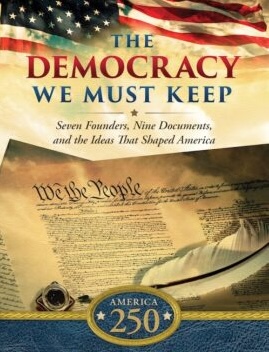
Ep3 The David O. Stewarta Show, Season 1 The Democracy We Must Keep: This month, we interview George Goodwin, author of “Propaganda Wars of the American Revolution”

August 2026 — This month on the David O. Stewart Show, we discuss Chapter 2 in “The Democracy We Must Keep” and learn about the work of Thomas Paine in December 1775
In today’s conversation, David interviews author and historian George Goodwin. As an Englishman himself, George will give us insight into a fellow British author and a renegade who, in January 1776, wrote Common Sense, a pamphlet that demolished every intellectual defense of tyrannical, one-man rule. David explains, “Having lived in America for barely a year, Paine fired the spirit of revolution throughout the 13 colonies, becoming the bestselling author of 18th century America.”
About this month’s guest: George Goodwin is the author of four highly-acclaimed historical studies. The latest of these is x which followed his Benjamin Franklin in London: The British Life of America’s Founding Father, also published by Yale University Press (USA) in 2017. His previous works were Fatal Colours – Towton 1461(2012),on the reign of Henry VI and the 1st War of the Roses; andFatal Rivalry — Henry VIII, James IV and the battle for Renaissance Britain, Flodden 1513, (2013)both published by W.W. Norton (USA). Learn more: georgegoodwin.com
David asks:
- It’s hard to escape the irony that Thomas Paine, whose first printed work in America sold more copies than that of any other writer in the 18th Century, was an Englishman, and came to America in his late 30s. Can you give our listeners a sense of his career before he got here?
- That best-seller by Paine that I just mentioned was, of course, Common Sense, a pamphlet that sold more than 150,000 copies – sales figures that both of us might enjoy. It came out in December 1775: Why did he write it then?
- Can you offer a capsule version of his message to Americans?
- In those pre-digital days, can we track the impact the pamphlet had on Americans? Was it sold in Britain? Did it have any impact there, or on the British officers and soldiers in America?
- Was there something in his writing style that accounted for the remarkable popularity of Common Sense?
- How about its method of argument?
- I was bemused by his clever use of Biblical stories to support his anti-monarchy arguments, pointing out that the Bible’s Books of Kings depict most kings as evil. He certainly scored points with the argument, but he was an atheist, so do you find it odd for him to turnito the bible as authority?
- As a connoisseur of skillful propaganda, how would you judge the quality of this runaway best seller?
- Paine was no kind of soldier—why did General Washington give him a military rank in the Continental Army?
- Somewhat less known is that in Common Sense, Paine wrote thirteen more pamphlets through to the end of the war, titling them The American Crisis. How did the American public greet that second round of propagandizing?
- How do you judge those later writings as propaganda? Was his writing growing stale, or was his act just becoming a bit shopworn?
- Paine would have a pattern of overstaying his welcome over the rest of his life. What caused him to leave America, the scene of his greatest success?
- Did he ever return to the United States?
Don’t miss it!
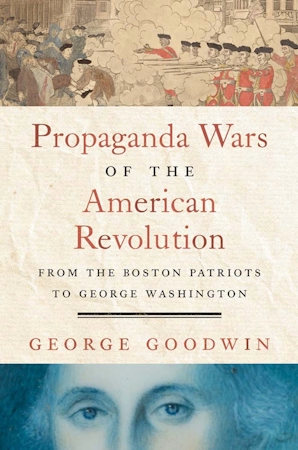
“Propaganda Wars of the American Revolution,” by George Goodwin
About Propaganda Wars of the American Revolution: The book is a revelatory account of how words and actions combined to destroy Britain’s colonial rule and secure Washington’s American victory.
The American Revolution was not only fought on bloody battlefields, it was waged with the ink of pen and print. George Goodwin shows how the leaders of the American Revolution brilliantly weaponized information and propaganda through correspondence and newspapers, shaping public perception, mobilizing support, and swaying the colonies toward open rebellion. Once the war began, George Washington’s tireless ability to deploy the pen and press as a weapon of war helped to unite and sustain very different colonies and colonists during the eight long years before victory.
Drawing on a wealth of contemporary accounts, letters, and publications, Goodwin demonstrates how liberty and authority were contested through ideas, images, and rhetoric at the time of America’s birth—and how, 250 years on, the Revolution can be seen as America’s first great media war. Buy the book.

Author and historian David O. Stewart
Meet David O. Stewart: A trial and appellate lawyer for many years, David writes history and historical novels. He has received the Lifetime Achievement Award from the Washington Independent Review of Books, was a reporter for the Staten Island Advance, and for 10 years wrote the monthly Supreme Court column for the American Bar Association Journal. He has also done on-air commentary for CNN, C-SPAN, Bloomberg News, and MSNBC.
About his newest book, The Democracy We Must Keep:
What did America’s founders say about democracy—and can we remain true to their vision for America? Two hundred fifty years ago, passionate men attempted to create something the world had never seen before: a nation built not on kings or armies, but on ideas where the people ruled. In The Democracy We Must Keep, historian David O. Stewart takes readers inside the nine key documents that shaped the formation of the United States—from Patrick Henry’s thunderous cry for liberty to the carefully crafted design of a government chosen by the people, with limits on all officials holding power under the Constitution.
Through the words of seven visionary founders—Washington, Jefferson, Madison, Hamilton, Gouverneur Morris, and others—Stewart shows how a fragile experiment in self-government took shape. These men were not saints. They argued passionately. They worried that the new nation might fall apart. Yet together, they forged the principles that must still define American democracy: That power must be limited. That leaders must answer to the people. That individual rights must be protected by law.
As the United States celebrates its 250th anniversary, The Democracy We Must Keep urges readers to rediscover core ideas that built the nation—and to consider what it will take to protect them. Accessible, engaging, and timely, this book is for anyone who wants to understand how American democracy started, and why it still matters. Learn more: davidostewart.com • Click here to buy David’s books