September242026
Ep5 The Constitution: David talks with Mary Sarah Bilder, a Boston College Law professor, and author of “Madison’s Hand”


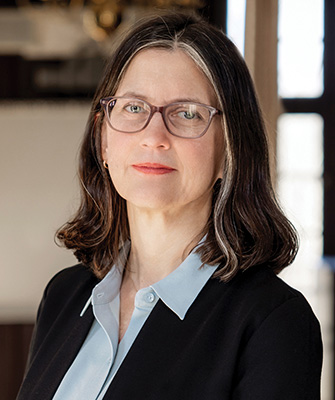
October 2026 —This month, David interviews Mary Sarah Bilder, a leading constitutional law scholar who teaches at Boston College Law School. In addition to surveying the events of the Summer of 1787 in Philadelphia, when America’s Founding Document was created, David and Mary will consider how James Madison played fast and loose in his previously unassailable notes from the Constitutional Convention. “This was the hottest Founding Era Scandal since Fawn Brodie broke the Sallie Hemings story,” David insists.
About Mary Sarah Bilder:Mary teaches American legal and constitutional history, as well as property, trusts and estates. In 2016, she was named the Founders Professor of Law at Boston College. Her recent scholarship focuses on the early history of the Constitution: the concept of a Framing Generation; Native Nations and the 1787 Constitution; the early constitutional status of women; written constitutionalism as a new genre; James Madison’s Notes of the Convention; the history of judicial review; and colonial and founding era constitutionalism. She is currently working on a constitutional biography of Catharine Macaulay. Click here to learn more about Mary • Find her five books here.
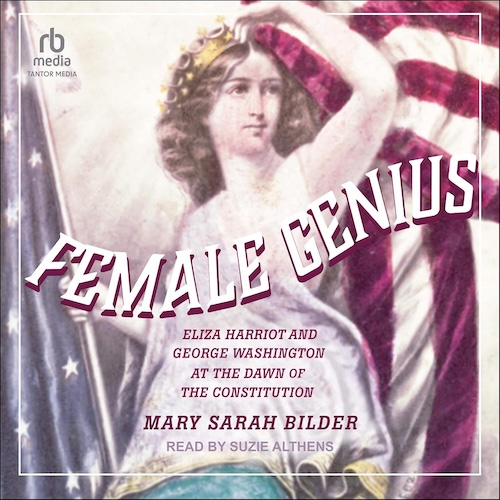 About Female Genius: Eliza Harriot and George Washington at the Dawn of the Constitution — In this provocative biography, Mary Sarah Bilder looks to the Age of the Constitution to investigate the rise of a radical new idea in the English-speaking world: female genius. Bilder finds the perfect exemplar of this phenomenon in Eliza Harriot Barons O’Connor. This pathbreaking female educator delivered a University of Pennsylvania lecture attended by George Washington as he and other Constitutional Convention delegates gathered in Philadelphia. As the first such public female lecturer, her courageous performance likely inspired the gender-neutral language of the Constitution.
Female Genius reconstructs Eliza Harriot’s transatlantic life, paying particular attention to her lectures and the academies she founded, inspiring countless young American women to consider a college education and a role in the political forum. Promoting the ideas of Mary Wollstonecraft, Eliza Harriot brought the concept of female genius to the United States. Its advocates argued that women had equal capacity and deserved an equal education and political representation. Its detractors, who feared it undermined male political power, felt deeply threatened. By 1792 Eliza Harriot experienced struggles that reflected the larger backlash faced by women and people of color as new written constitutions provided the political and legal tools for exclusion based on sex, gender, and race.
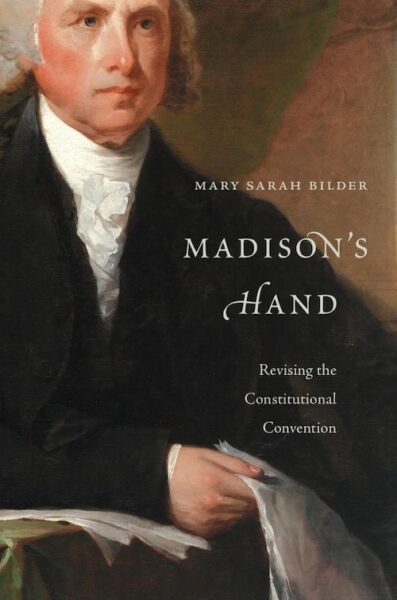 About Madison’s Hand: Revising the Constitutional Convention — James Madison’s Notes on the 1787 Constitutional Convention have long been treated as the definitive account of the Constitution’s creation. No other document offers a fuller record of the deliberations in Philadelphia or portrays the Convention’s charismatic figures, crushing disappointments, and hard-won compromises with such narrative force. But how reliable is this record?
In a groundbreaking study that combines digital tools with traditional textual analysis, Mary Sarah Bilder shows that Madison revised his Notes far more extensively than scholars had realized. Initially kept as a near-daily diary, the Notes were abandoned at a crucial point and left unfinished. Madison returned to them only years later, largely with Thomas Jefferson in mind as his audience―by which time his thinking had been reshaped by the new government’s early struggles and Jefferson’s political ideas. His evolving vision of republican government, his Virginia allegiances, his openness to constitutional protections for slavery, his interest in political maneuvering, and his portrayals of figures such as Alexander Hamilton and Charles Pinckney all shifted through successive rounds of revision. When the Notes were finally published in 1840, the layers of revision were invisible.
Madison’s Hand uncovers the history of this influential manuscript and shows how a single, much-reworked document came to dominate our understanding of the Constitution’s origins. Click here to buy the book.
Mary’s book, Transatlantic Constitution: Colonial Legal Culture and the Empire(Harvard University Press), received the Littleton-Griswold Award from the American Historical Association.
Her most recent book,Female Genius: Eliza Harriot and George Washington at the Dawn of the Constitution (University of Virginia Press), was also named a finalist for the George Washington Book Prize. Learn more here.

Author and historian David O. Stewart
Meet David O. Stewart: A trial and appellate lawyer for many years, David writes history and historical novels. He has received the Lifetime Achievement Award from the Washington Independent Review of Books, was a reporter for the Staten Island Advance, and for 10 years wrote the monthly Supreme Court column for the American Bar Association Journal. He has also done on-air commentary for CNN, C-SPAN, Bloomberg News, and MSNBC.
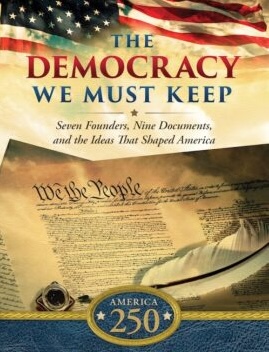
About his newest book, The Democracy We Must Keep:
What did America’s founders say about democracy—and can we remain true to their vision for America? Two hundred fifty years ago, passionate men attempted to create something the world had never seen before: a nation built not on kings or armies, but on ideas where the people ruled. In The Democracy We Must Keep, historian David O. Stewart takes readers inside the nine key documents that shaped the formation of the United States—from Patrick Henry’s thunderous cry for liberty to the carefully crafted design of a government chosen by the people, with limits on all officials holding power under the Constitution.
Through the words of seven visionary founders—Washington, Jefferson, Madison, Hamilton, Gouverneur Morris, and others—Stewart shows how a fragile experiment in self-government took shape. These men were not saints. They argued passionately. They worried that the new nation might fall apart. Yet together, they forged the principles that must still define American democracy: That power must be limited. That leaders must answer to the people. That individual rights must be protected by law.
As the United States celebrates its 250th anniversary, The Democracy We Must Keep urges readers to rediscover core ideas that built the nation—and to consider what it will take to protect them. Accessible, engaging, and timely, this book is for anyone who wants to understand how American democracy started, and why it still matters. Learn more: davidostewart.com • Click here to buy David’s books